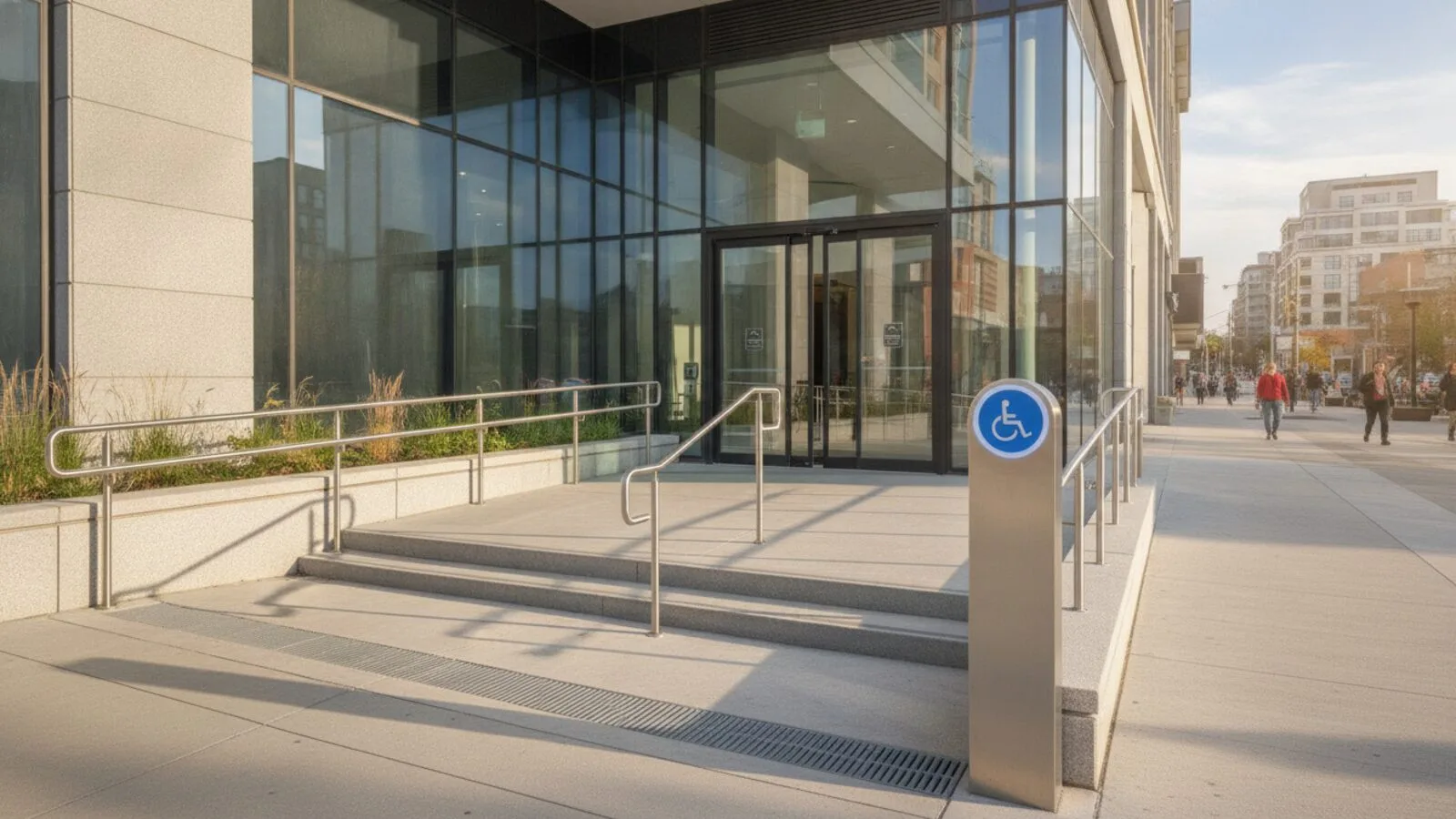
Automatic Door Accessibility Requirements for Ontario Businesses
Accessible entrances are both a legal expectation and good business in Ontario — and the rules that govern them often confuse owners because they live in two different places. This guide explains how Ontario's accessibility laws and its Building Code work together, what they mean for automatic doors and power door operators, and where to find the official provincial sources so you can verify everything yourself. It is a plain-language overview, not legal advice; for a binding interpretation, consult the regulations directly or a qualified professional.
Two rulebooks: the AODA and the Ontario Building Code
The first is the Accessibility for Ontarians with Disabilities Act, 2005 (AODA), which sets out a process for developing and enforcing accessibility standards that businesses, non-profits and public-sector organisations must follow. The second is Ontario's Building Code, which governs how buildings must be built or substantially renovated — including barrier-free design and where power door operators are required. As the province explains on its accessibility laws overview, these are complementary but separate: the AODA and its Design of Public Spaces standard do not govern the construction of buildings, while accessibility at the time of construction or major renovation is governed by the Building Code, administered by the Ministry of Municipal Affairs and Housing.
What the AODA requires of businesses
Under the AODA's Integrated Accessibility Standards Regulation (O. Reg. 191/11), the obligations that apply to your organisation depend on its size. The province's guide to the accessibility rules for businesses and non-profits breaks it down: organisations with fewer than 20 employees must create accessibility policies and train staff; organisations with 20 or more employees must additionally file an accessibility compliance report; and organisations with 50 or more must also document a multi-year accessibility plan. The current deadline to file an accessibility compliance report is December 31, 2026, and the province treats filing that report as a legal obligation under the AODA.
The Design of Public Spaces standard
The AODA's Design of Public Spaces standards set a baseline level of accessibility for spaces such as parking lots, sidewalks, service counters, fixed waiting lines and waiting areas. Importantly, these standards apply to new construction and to existing public spaces that are being redeveloped — not to spaces that are simply being maintained. The province's practical guidance on how to make public spaces accessible is a useful companion to the regulation.
Power door operators and the Building Code
For the automatic door itself — the powered operator that opens a door at the push of a button or a wave — the governing rules sit in the Ontario Building Code rather than in the AODA. The Code has carried barrier-free design requirements for decades, and its 2015 barrier-free amendments increased the requirements for power door operators, extending them to a wider range of building entrances and to the entrances of barrier-free washrooms and common rooms in multi-unit residential buildings. Later changes that took effect in January 2020 clarified, among other things, the required locations of power door operators and building control devices. Because these obligations are triggered at the point of construction or major renovation, the practical takeaway is this: if you are building, renovating, or upgrading an entrance, the Building Code is where the operator requirements live, and you should confirm the current edition's provisions with your designer or municipal building department.
What this means for your entrance
Putting it together: the Building Code may require a power door operator when you build or substantially renovate an entrance, and the AODA requires you to keep your business accessible and your accessibility obligations met on an ongoing basis. Both point in the same direction — a powered, accessible entrance that actually works. That is where ongoing service matters. An accessible push-button operator that is broken, mis-set, or so slow it strands a wheelchair user in the doorway is not serving its purpose, whatever the paperwork says. Installing the right operator is the first step (see our accessible door operators service), and keeping it working through regular maintenance and an annual safety inspection is what keeps your entrance genuinely accessible day to day.
Verify with the official sources
Accessibility rules change, so always check the current text. The authoritative provincial sources are: the AODA statute, the Integrated Accessibility Standards Regulation, the accessibility rules for businesses and non-profits, and the page on accessibility requirements under Ontario's Building Code. For help specifying or servicing a compliant accessible entrance across Toronto and the GTA, get in touch with our team. If your existing door is acting up, our troubleshooting guide and service-schedule guide are good next reads.
Frequently asked questions
Does my Ontario business legally have to install an automatic door?
Not automatically. Power door operators are required by the Ontario Building Code at the point of new construction or major renovation for certain entrances, rather than being mandated for every existing storefront by the AODA. Whether a given project triggers the requirement depends on the building, the scope of work and the current Code edition — confirm with your designer or municipal building department.
What is the difference between the AODA and the Ontario Building Code here?
The AODA and its Integrated Accessibility Standards Regulation set ongoing accessibility obligations for organisations and a baseline for the design of certain public spaces, but they do not govern building construction. The Ontario Building Code governs barrier-free design and power-door-operator requirements at the time a building is built or substantially renovated.
When is the AODA accessibility compliance report due?
Per the province, businesses and non-profits with 20 or more employees must file an accessibility compliance report, and the current deadline is December 31, 2026. Organisations with fewer than 20 employees do not file a report but still must meet the applicable accessibility requirements.
Door trouble, or planning an upgrade?
Talk to a technician about same-day service and upfront quotes across Toronto & the Greater Toronto Area.